
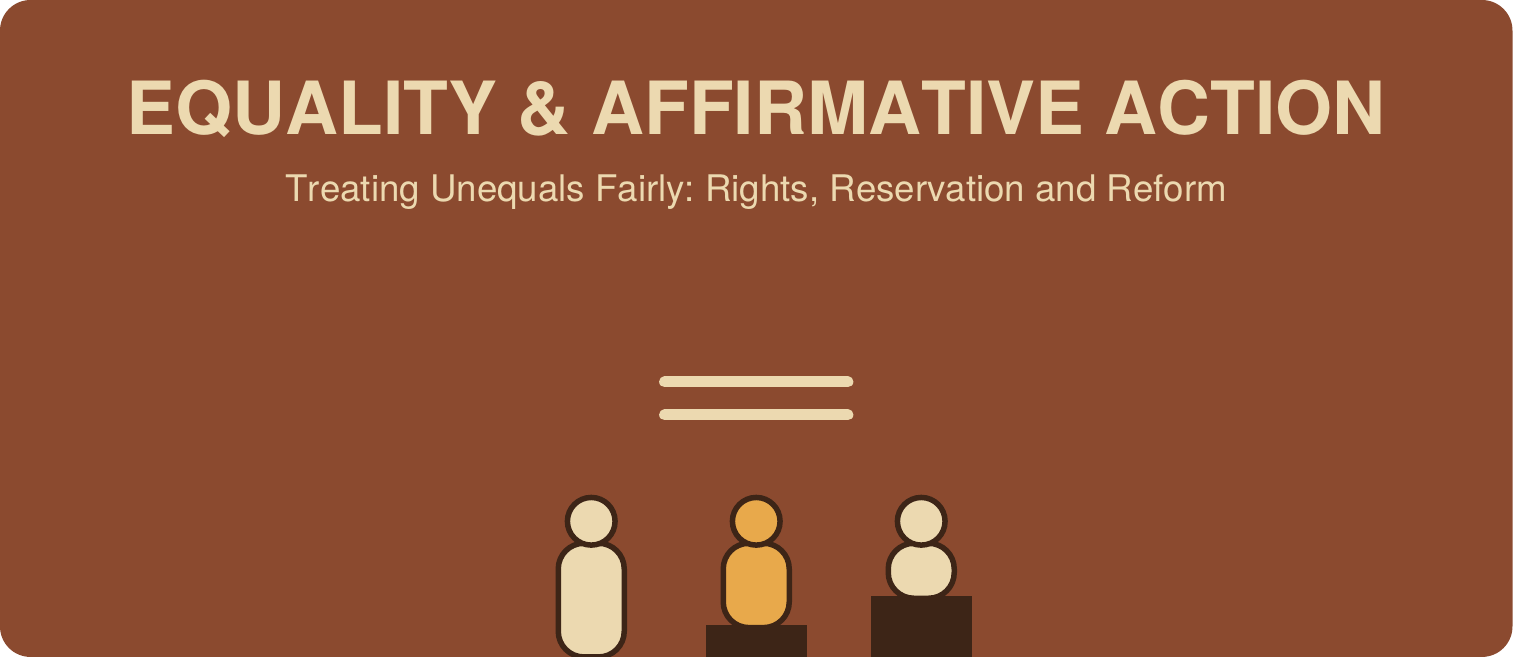
Equality is the first promise of the Indian Constitution, yet it does not mean treating everyone identically. A society with a long history of caste, gender and social disadvantage needs more than formal equality. It needs measures that help people reach a fair starting point. This blog explains the constitutional scheme on equality and non-discrimination, the law on affirmative action and a recent Supreme Court ruling on the OBC creamy layer.
The Constitutional Scheme
- Article 14: Equality before the law and equal protection of the laws.
- Article 15: No discrimination by the State on grounds of religion, race, caste, sex or place of birth. Articles 15(3), 15(4), 15(5) and 15(6) allow special provisions for women and children, for socially and educationally backward classes, Scheduled Castes and Scheduled Tribes, and for economically weaker sections.
- Article 16: Equality of opportunity in public employment, with Articles 16(4) and 16(4A) allowing reservation for backward classes and for Scheduled Castes and Scheduled Tribes in promotions, and Article 16(6) for economically weaker sections.
- Article 17: Abolition of untouchability.
- Article 46: A Directive Principle to promote the educational and economic interests of weaker sections.
How the Courts Read Equality
- In E.P. Royappa v. State of Tamil Nadu (1974), the Supreme Court held that arbitrariness is the opposite of equality.
- In NALSA v. Union of India (2014), the Court recognised the rights of transgender persons, and in Navtej Singh Johar v. Union of India (2018), it read the guarantee against discrimination to cover sexual orientation.
- Formal equality treats everyone the same. Substantive equality looks at real disadvantage and allows differences in treatment to remove it.
Landmark Cases on Affirmative Action
- Indra Sawhney v. Union of India (1992): The Court upheld OBC reservation, set a general ceiling of 50 per cent and required exclusion of the creamy layer among OBCs.
- M. Nagaraj v. Union of India (2006): Reservation in promotions requires quantifiable data on backwardness and inadequate representation, while preserving administrative efficiency.
- Janhit Abhiyan v. Union of India (2022): By a 3:2 majority, the Court upheld the 103rd Amendment providing reservation for economically weaker sections.
- State of Punjab v. Davinder Singh (2024): A seven-judge Bench held that States may sub-classify Scheduled Castes in appropriate cases, if supported by data.
A Recent Ruling: The OBC Creamy Layer
In Union of India v. Rohith Nathan, the Supreme Court held on 11 March 2026 that a parent’s salary alone cannot decide whether an OBC candidate is in the creamy layer, and that the 1993 Office Memorandum governs. On 6 November 2026, the Court reaffirmed this and rejected the Centre’s plea to apply it only prospectively, for the candidates of the Civil Services Examination 2025 before it.
The Debate
- Supporters say reservation corrects historic disadvantage and gives fair representation.
- Critics ask whether benefits reach the most deserving, and raise concerns about merit and about caste-based or economic criteria.
- Courts try to balance these views through tests such as the creamy layer, data requirements and the ceiling on reservation.
- The 106th Amendment of 2023 provides one-third reservation for women in the Lok Sabha and State Assemblies, to take effect after the next census and delimitation.
In conclusion
Equality in India is a continuing project. The Constitution guards against discrimination and also allows the State to correct deep social inequalities. Courts keep measuring each measure against fairness and reason, and students should follow this evolving area of law closely.