

Why do some people break rules even when they accept the values of their society? The American sociologist Robert K. Merton (1910–2003) offered an influential answer in his essay Social Structure and Anomie (1938). He argued that deviance often arises from a strain between what society tells people to want and the legitimate ways it gives them to achieve it. This blog explains strain theory in simple terms and shows why it matters for sociology and law.
The Core Idea
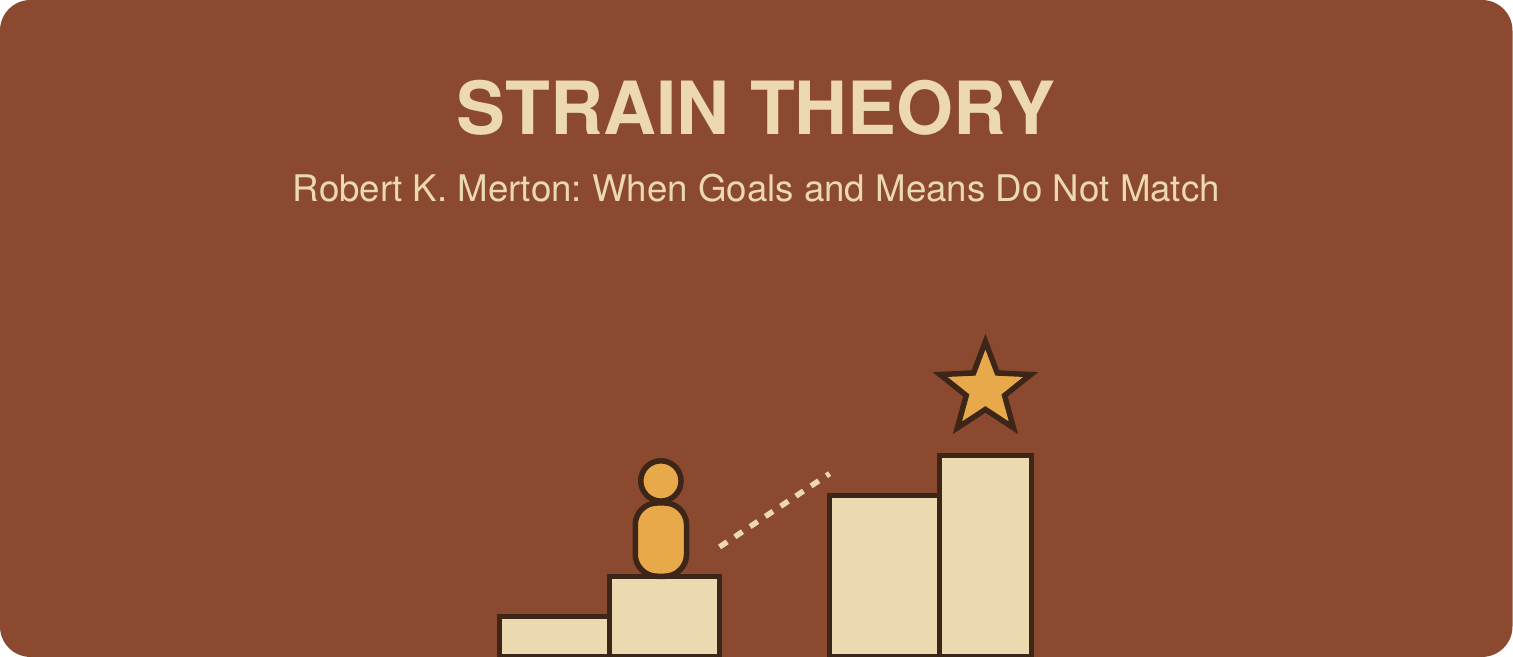
Merton built on Émile Durkheim’s concept of anomie, a condition in which social norms fail to guide behaviour. He observed that every society sets cultural goals, such as wealth, success and status, and also approves institutionalised means to reach them, such as education, work and savings. When the goals are stressed for everyone but the means are available only to some, strain arises, and people may respond in different ways.
Merton’s Five Modes of Adaptation
- Conformity: The person accepts both the goals and the approved means. This is the most common response.
- Innovation: The person accepts the goals but uses unapproved means, as in fraud, theft or other crime committed for gain.
- Ritualism: The person gives up the goals but keeps following the rules, as in an employee who sticks to routine without hope of advancement.
- Retreatism: The person rejects both goals and means and withdraws from mainstream society.
- Rebellion: The person rejects both and seeks to replace them with new goals and means, as in radical social movements.
Why the Theory Matters
- It shifts attention from individual character to social structure, since deviance can be a response to blocked opportunity.
- It explains how poverty, unemployment and unequal access to education can raise the risk of crime.
- It helps us look at crimes committed for gain, including financial and cyber fraud.
Later Developments
- Cloward and Ohlin (1960) added the idea that illegitimate opportunities, such as access to criminal groups, are also unequally distributed.
- Robert Agnew’s General Strain Theory (1992) widened the idea of strain to include failure to achieve goals, loss of valued things and negative treatment, which can lead to anger and deviance.
Strain Theory in Today’s India
- Rising aspirations for jobs, income and status may not match available opportunities, especially for young people in competitive education and a tight job market.
- Pressure to succeed can lead some to take shortcuts, such as cheating in examinations or involvement in online fraud.
- Others may withdraw or disengage, which makes counselling, guidance and support important.
Criticisms
- The theory focuses on crimes for economic gain and explains less about violent or impulsive offences.
- It assumes broad agreement on goals, though people and cultures value different things.
- It does not explain why people in the same situation choose different responses, and it says little about gender.
In conclusion
Strain theory teaches that deviance is not only a matter of bad individuals. It also reflects a society’s structure of goals and opportunities. For lawyers and policymakers, the lesson is that crime prevention needs both enforcement and fair access to education, work and a fair chance to succeed.